
Composite Containers: Durable and Versatile Packaging Solutions
What are Composite Containers?
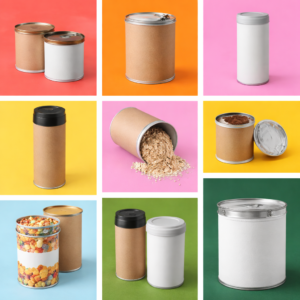
Composite containers are specialized canisters manufactured from a blend of constituent materials. Generally, these units consist of paper, high-grade boards, and Kraft paper, which are then reinforced with metal or plastic ends. In various industrial sectors, this packaging is frequently referred to as a “Combican.”
To ensure maximum durability, a laminated version is created. In this process, Kraft paper and boards are laminated with polyethylene and heat-sealed with a membrane. By utilizing this multi-layered approach, the container is made 100% leakproof, providing a secure environment for sensitive goods.
Common Industry Applications of Composite Containers
Because of their versatile nature, composite containers are utilized across a vast array of sectors. Currently, they are frequently seen in the packaging of:
Food Products: Spices, custard powder, masala, processed foods, and various milk derivatives.
Pharmaceuticals & Chemicals: Tablets, capsules, pesticides, and detergent powders.
Liquor & Beverages: Spirits and non-carbonated drinks.
Furthermore, when the laminated variety is used, the scope of application widens significantly. Consequently, these containers are considered suitable for high-moisture items such as jams, fruit pulps, frozen vegetables, and motor oil.
Key Advantages of Composite Packaging
There are several reasons why manufacturers are shifting away from traditional materials. First and foremost, composite containers are light in weight, inexpensive, and entirely non-corrosive when compared to standard tin alternatives.
Additionally, this format is recognized as a disposable packaging solution that effectively supports goods with a shelf life of one to two years. From an ecological perspective, these units are considered environmentally friendly. It is also worth noting that for volumes up to 1 liter, the structural stability of the can is often found to be superior to both glass and tin.
Manufacturing and Structural Composition
The production of composite containers is typically handled through two primary techniques: the convolute method or the spiral winding method. Regardless of the method chosen, the final product is normally comprised of five essential components:
The Liner: Provides the internal barrier.
The Body Wall: Offers structural integrity.
The Label: Used for branding and information.
The Bottom End: Usually metal or plastic.
The Top End: Often includes a seal or pull-tab.
Quality Grades and Functionality
In the current market, two distinct quality grades of composite containers are manufactured to meet specific needs. The first is the standard “Packaging Can,” which is built tight enough to hold lumpy products, granules, and general powders.
The second grade is the “Instant Can.” This version is engineered to be tight enough for hygroscopic products, such as instant coffee or tea. By using a heat-sealed internal web, caking and clog formation are prevented because humidity penetration is blocked. Through this advanced sealing technology, even liquid penetration is contained, ensuring that composite containers remain a top choice for modern logistics.