
Multihead Weigher: The Formula for Zero-Waste Packaging
Introduction
If you’ve ever wondered how a bag of potato chips hits exactly 50g every single time at a speed of 120 bags per minute, you’re looking at the work of a Selective Combination Weighing Machine. Commonly known as a Multihead Weigher, this is the “brain” of the modern packaging line. It doesn’t just weigh; it calculates.
What is Multihead Weigher?
A Multihead Weigher with multiple weighing units, which computes an appropriate combination of loads to achieve the predetermined mass and discharges them together as a fill.
At its core, this machine is a high-speed math engine. Instead of trying to dump exactly 500g into one bucket, it distributes the product across 10, 14, or even 24 small “heads” (weigh hoppers).
The computer then looks at the weights in all those hoppers—say, 45g in one, 52g in another, and 48g in a third—and instantly picks the perfect combination that equals your target weight.
The Result: You get pinpoint accuracy (often within 0.1g to 0.5g) at speeds that manual weighing can’t touch.
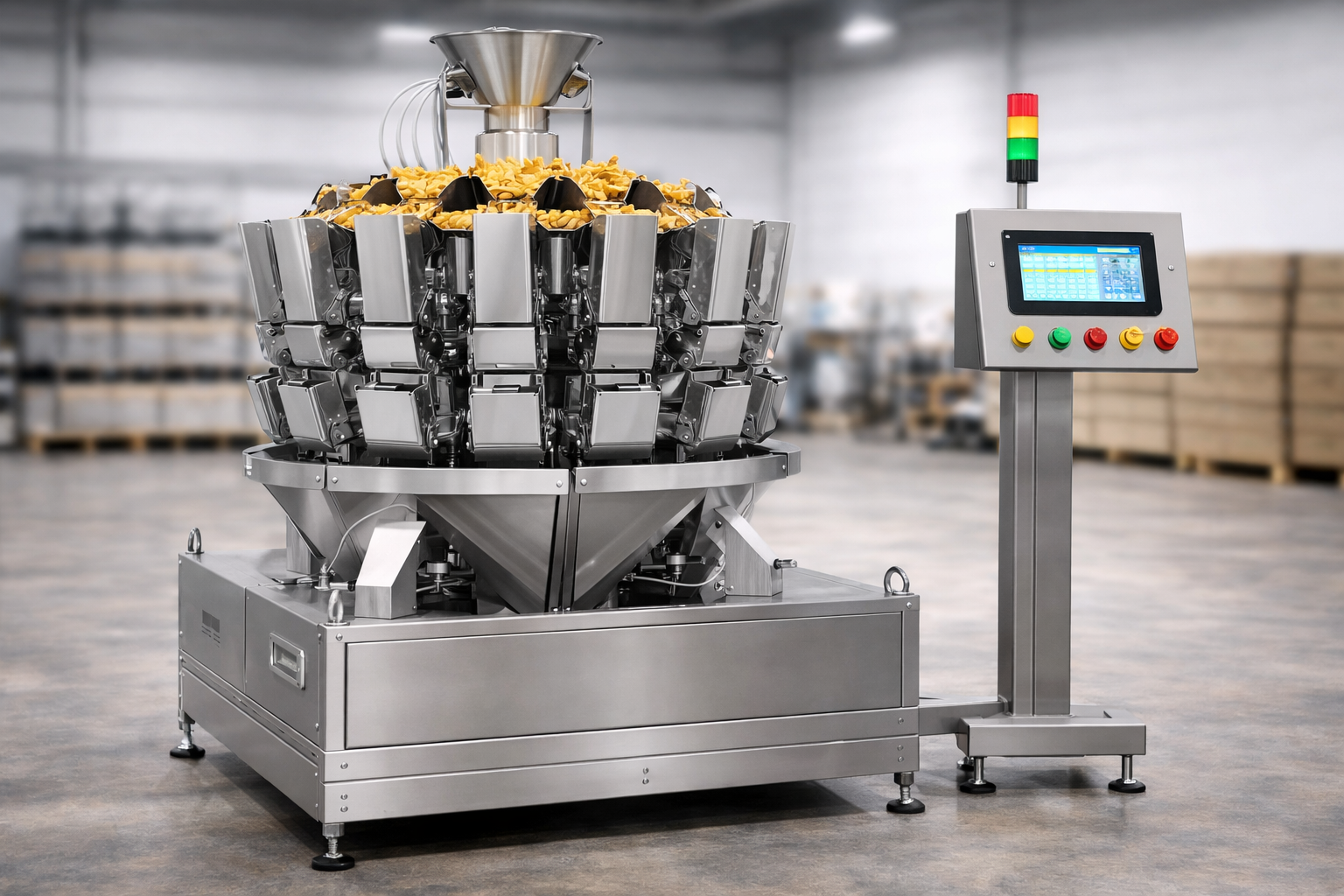
How the "Brain" Works in Milliseconds
- Distribution: Product drops onto a top cone and is vibrated out to individual feed buckets.
- The Weigh-In: Feed buckets drop the product into weigh hoppers equipped with ultra-precise load cells.
- The Math: The PLC (Programmable Logic Controller) scans the weights in all hoppers.
- The Selection: It identifies, for example, that hoppers #3, #7, and #12 combined equal exactly 100.2g.
- The Dump: Only those specific hoppers open, discharging the product into the bagging machine below.
Where It Wins (And Where It Doesn’t)
The Power Players:
Snacks & Crisps: Essential for lightweight, high-volume items like chips or popcorn.
Sticky or Frozen Foods: Special “dimpled” metal surfaces prevent frozen nuggets or gummies from sticking.
Fragile Goods: Designed with shallow angles to prevent cookies or crackers from shattering.
The Trade-offs:
Footprint: These machines are vertical giants; you need significant ceiling height.
Cleaning: With 14+ hoppers to wash, changeovers can take longer than simpler systems.
Complexity: You need an operator who understands the interface, not just someone who can flip a switch.
Sorting the Types of Multihead Weigher: Which One Do You Need?
| Type | How It Differs | Best For… |
| Multihead (Standard) | 10 to 24 heads arranged in a circle. | High-speed snacks, candy, and nuts. |
| Linear Weigher | Heads arranged in a row; feeds by gravity/vibration. | Heavier, free-flowing items (Sugar, Rice) where “good enough” accuracy works. |
| Rotary Combination | Advanced, continuous motion systems. | Ultra-high-volume industrial plants (200+ PPM). |
The "Pro" Buying Guide for Pre-Owned Multihead Weigher
Buying used can save you 40-60% off the sticker price, but only if you check these four “Red Flags”:
The “Dimple” Factor: If you are packing sticky items (dried fruit, meat), ensure the hoppers have a dimpled (embossed) surface. Smooth stainless steel will cause your product to “slug” and ruin your accuracy.
Load Cell Health: These are the “nervous system” of the machine. Ask the seller for a “repeatability test.” If the machine gives different readings for the same weight five times in a row, the load cells are exhausted.
Springs and Hinges: On used machines, the hopper gates are the first things to fail. Check for snappy movement. If they’re sluggish, you’ll deal with “double-dumping” errors.
IP Rating: If you’re in frozen food or meat, the machine must be wash-down rated (IP65 or higher). A used machine with rusty electronics is a liability.
Ready to Optimize Your Throughput?
At SurplusPack, we bridge the gap between high-end technology and sensible budgets. Whether you’re looking to offload a 10-head weigher or scale up to a 20-head system, we connect you with verified equipment that’s ready to run.
Want to Buy a Machine?
Want to Sell Your Machine?
FAQs
1. What is a Multihead Weigher machine?
A combination weighing machine is a system that uses multiple weigh heads to achieve precise and efficient product weighing for packaging.
2. Which type of weigher is best for high-speed production?
Multihead and rotary combination weighers are best suited for high-speed and large-scale production due to their advanced design and accuracy.
3. What products can be used with multihead weigher?
They are commonly used for snacks, dry foods, granules, nuts, frozen foods, and other free-flowing products.
4. Is a linear weigher suitable for all products?
No, linear weighers are best for simple and uniform products, while complex or sticky items require multihead systems.
5. Why is accuracy important in weighing machines?
Accuracy ensures consistent product quantity, reduces wastage, and improves overall packaging efficiency.