
Staple Closing Machine: Heavy-Duty Solutions for Secure Carton Sealing
Introduction to the Staple Closing Machine
For industries dealing with heavy-weight goods or rigorous shipping conditions, the staple closing machine remains the gold standard for structural integrity. Unlike adhesive or tape, which can fail under extreme temperatures or high tension, a stapler machine uses industrial-grade metal fasteners to mechanically lock carton flaps together. This system is a staple in logistics, heavy manufacturing, and export warehousing where a “zero-fail” sealing policy is required.
What is a Staple Closing Machine?
This equipment is designed to close cartons by inserting and clinching metal staples for a firm seal. It is ideal for heavy-duty packaging where adhesive or tape may not be sufficient.
It ensures durability and secure closure during transit.
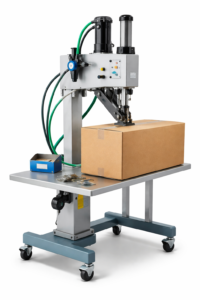
How the Mechanical Stapling System Works
The operation of a professional staple closing machine involves a high-pressure clinching mechanism:
Alignment: The carton flaps are folded and positioned under the clinching head.
Staple Driving: The machine drives a wide-crown staple through the double-wall or triple-wall corrugated board.
Clinching: As the staple penetrates the board, the machine’s “anvils” curve the staple legs upward and back into the underside of the corrugated material.
Security Check: The resulting “blind clinch” ensures the staple does not protrude into the box, protecting the internal contents while providing maximum pull-strength.
Key Industrial Applications
Export Shipping: Essential for sea freight where humidity can cause tape adhesive to fail.
Heavy Manufacturing: Ideal for appliances, automotive parts, and machinery components.
Bulk Food Distribution: Used for large-scale “master cases” that hold multiple smaller retail units.
Operational Constraints
While a staple closing machine offers unmatched strength, businesses should note:
Substrate Requirements: Not recommended for thin, single-wall fluting as the staple may tear the board.
Safety & Disposal: End-users must use tools to open stapled cartons, and the metal must be separated for recycling.
Tooling Wear: The driver blades and anvils require periodic sharpening or replacement.
Equipment Classifications
Depending on your $BPM$ (Boxes Per Minute) requirements, systems are categorized by power source:
Manual Hand Staplers: Best for low-volume top-sealing or onsite repairs.
Pneumatic Systems: Utilizing compressed air, a pneumatic stapler machine offers high speed and reduced operator fatigue for medium-scale lines.
Fully Automatic Case Staplers: Integrated into conveyor lines to sense box height and apply multiple staples simultaneously without manual intervention.
Technical Checklist: Buying a Pre-Owned Staple Closing Machine
When evaluating secondary market equipment, focus on the mechanical wear points:
| Factor | Critical Verification |
| Clinch Adjustment | Ensure the “depth of penetration” and “tightness” settings are functional. |
| Head Condition | Inspect the driver blade and anvils for chips or misalignment. |
| Magazine Capacity | Check for compatibility with standard coil or stick staple sizes. |
| Air Consumption | For pneumatic models, verify $CFM$ (Cubic Feet per Minute) requirements. |
| Safety Features | Confirm the presence of finger guards and trigger lockouts. |
Final Thoughts
A staple closing machine is a critical investment for businesses moving high-density or high-value products. By choosing a mechanical closure, you significantly reduce the risk of transit damage and tampering.
Looking for a Reliable Packaging Solution?
Whether you are scaling up your warehouse or replacing an aging unit, we can connect you with vetted suppliers of both new and refurbished stapling systems. Share your box dimensions and daily volume to get started.
FAQs
What is a Staple Closing Machine used for?
A Staple Closing Machine is used to seal cartons and boxes using metal staples, ensuring strong and secure packaging.
What is the price of a Staple Closing Machine in India?
Is a Staple Closing Machine better than tape sealing?
Yes, it provides stronger and more durable sealing, especially for heavy or bulk packaging, compared to tape sealing.