
What is a Gravimetric Filling Machine? The Ultimate Guide to Precision Filling
Introduction
In industries where every gram counts, a Gravimetric Filling Machine is the gold standard for accuracy. Unlike volumetric fillers—which can be affected by changes in temperature, aeration, or viscosity—gravimetric systems fill by liquid or solid weight. This ensures that whether you are bottling a thick chemical or a light powder, the customer gets exactly what is promised on the label.
What is a Gravimetric Filling Machine?
A Gravimetric Filling Machine is a weight-based filling system that utilizes high-precision load cells to monitor the filling process in real-time. By measuring the mass of the product rather than its volume, these machines eliminate the inaccuracies caused by foam, bubbles, or fluctuating product density.
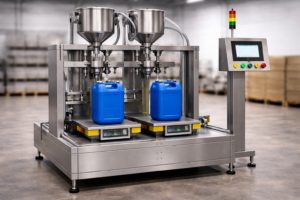
How the Process Works: Step-by-Step
The efficiency of a gravimetric system lies in its closed-loop feedback:
- Tare Measurement: The machine senses the empty container on the scale and “zeroes” it out (Tares).
- Bulk Fill: The product is dispensed at high speed to reach roughly 90% of the target weight quickly.
- Dribble Feed: The flow slows to a “fine feed” to drop the last few grams with pinpoint accuracy.
- Automatic Cut-off: Once the load cell hits the exact target, the valve snaps shut, preventing overfill.
Key Industry Applications
Chemicals & Lubricants: Essential for high-value solvents and oils where overfilling leads to massive profit loss.
Food & Beverage: Perfect for honey, sauces, and oils that change density based on ambient temperature.
Pharmaceuticals: Used for precise dosing of powders and liquid medications where safety is tied to weight.
Paints & Coatings: Necessary for heavy pails where “Gross Weight” filling is often the standard.
Types of Gravimetric Filling Systems
1. Net Weight Fillers:
These weigh the product in a separate internal hopper before it enters the container. This is the fastest method for high-speed production.
2. Gross Weight Fillers:
These weigh the container and the product together during the fill. This is ideal for bulk bags or large 5-gallon pails.
3. Semi-Automatic vs. Fully Automatic:
Semi-automatic units require an operator to place the bottle, while fully automatic systems integrated into a conveyor line can handle 20–100+ containers per minute.
Buying Guide: What to Look for in a Pre-Owned Machine
Buying used equipment is a great way to save on CAPEX, but a weighing system is a “smart” machine, which means you need to check the electronics carefully.
| Factor | What to Check |
|---|---|
| Load Cell Integrity | Ask for a calibration report. If the load cells are “drifting,” the machine is useless. |
| PLC & Software | Is the interface (HMI) in English? Can you still get software updates for that specific model? |
| Product Viscosity | Ensure the pumps/valves can handle your specific product (e.g., a water-filler won’t work for molasses). |
| Changeover Time | How easy is it to clean the nozzles and recalibrate for a different bottle size? |
| Spare Parts | Brands like Mettler-Toledo or Rice Lake have parts available globally; “no-name” brands can be hard to repair. |
Final Thoughts
Investing in a Gravimetric Filling Machine is an investment in waste reduction. While the initial cost is higher than a timed-flow filler, the ROI is found in the “giveaway” you save by never overfilling a bottle again.
Planning to Buy or Sell a Pre- Owned Gravimetric Filling Machine?
Connect with verified buyers and sellers to find the right machine or get the best value for your equipment.
Want to Buy a Machine?
Want to Sell Your Machine?
FAQs
What is a gravimetric filling machine?
A gravimetric filling machine fills products based on exact weight using load cells, ensuring high accuracy.
What products can be filled using a gravimetric filling machine?
It is suitable for liquids, powders, and granules such as oils, chemicals, grains, and pharmaceuticals.
What is the price of a gravimetric filling machine?
The price typically ranges from ₹1,50,000 to ₹10,00,000+, depending on capacity and automation.
Is a gravimetric filling machine accurate?
Yes, it offers high accuracy as it measures filling based on weight, reducing product loss and variation.